

 VN
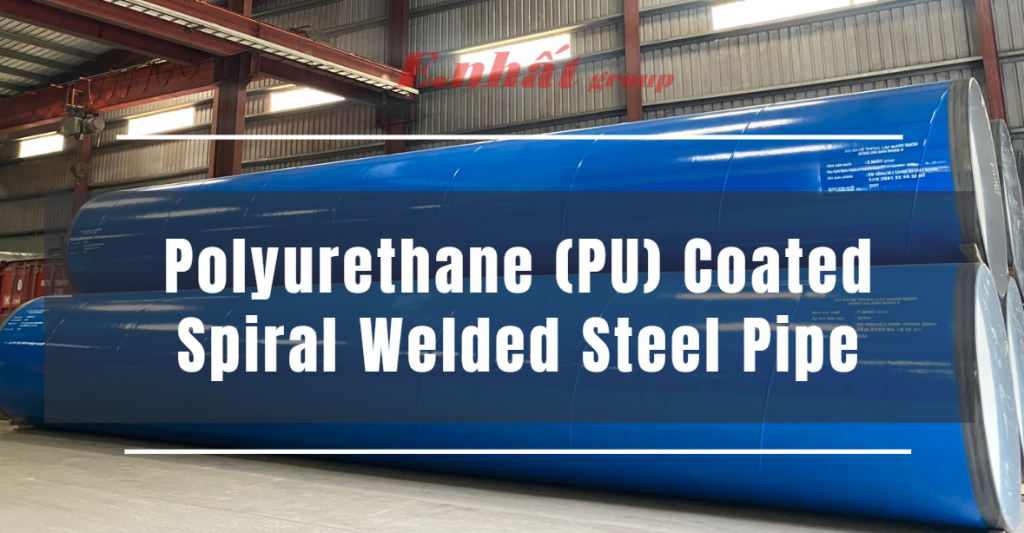
From a technical perspective, let’s learn about Polyurethane coating (AWWA C222) for spiral welded steel pipes (SSAW): durable, abrasion resistant, meets NSF/ANSI 61 for drinking water; quick comparison with Epoxy C210/FBE and system selection direction according to ISO 12944.
Overview: Why is Polyurethane (PU) popular?
Spiral welded steel pipes (SSAW) have the advantage of bearing capacity, flexible production of large diameters. When working in humid environments, corrosive soil or abrasive flows, the Polyurethane (PU) coating creates a durable, flexible, chemical-resistant anti-corrosion “barrier” and firmly adheres to the steel substrate – helping to prolong the life of the pipeline.
On the inner surface of the water supply pipe, 100% solids PU (no VOC) has the advantage of fast curing, easy to reach the required thickness, supporting the progress of the workshop/on the construction site; at the same time, it can meet the requirements for contact with drinking water according to NSF/ANSI 61 (depending on the product system).

Core standards framework (so that engineers and investors “speak the same language”)
- AWWA C222: provides minimum requirements for polyurethane coating/priming systems for spiral welded steel pipes and fittings (internal and external applications).
- For drinking water: PU for spiral welded steel pipes for water supply must be certified to NSF/ANSI 61 before being put into potable water service.
- ISO 12944: used to classify the environment (C1–C5/CX) and durability level (Low/Medium/High/VH), thereby selecting the appropriate coating system + total thickness, especially for the external surface of the pipe.
- For comparison/contrast, AWWA C210 applies to liquid epoxy – another popular choice in the water industry.
https://www.enhat.vn/en/tieu-chuan-awwa/
What is the difference between PU and Epoxy/FBE?
- Flexibility & Impact Resistance: PU tends to be flexible, with good bending/impact resistance – useful for transportation, installation, pulling HDD pipes… Meanwhile, Epoxy can become brittle/micro-cracking in a “spider web” shape if subjected to excessive force/bending.
- Construction/Progress: PU cures quickly (100% solids) → shortens waiting time, convenient for production lines and busy construction sites; Epoxy requires longer curing times with some systems.
- Drinking Water Certification: Both Epoxy (C210) and PU (C222) can be used for drinking water, as long as the specific product is NSF/ANSI 61.
Quick conclusion: If you need flexibility – abrasion/impact resistance – fast curing, PU (C222) for spiral welded steel pipes will be a strong choice. If classic/easy availability is a priority, Epoxy C210 for spiral welded steel pipes is a familiar counterpart.
PU system structure & construction process (streamlined – standard)
Typical structure:
(1) Clean the substrate (blasting) → (2) Primer/or PU directly according to TDS → (3) Finishing PU layer (can be one or more passes to achieve DFT) → (4) Inspection – acceptance.
Main steps:
- Surface preparation: clean rust/contamination; clean and rough level according to paint system instructions (refer to ISO 12944/ISO 8501 when needed).
- PU application: use 2-component sprayer (plural component) to achieve 100% solids, uniform and correct DFT according to specs/standards.
- Paint film thickness (DFT): the inner lining of drinking water pipes is usually ≥ 20 mils (≈ 500 μm) and can be thicker according to service/manufacturer requirements.
- QC/QA: measure DFT, check surface defects; additional tests (adhesion, impact, abrasion resistance, water permeability) according to TDS – compare with C222 and project standards.
- Transportation – installation: handle support, avoid impact on pipe edges; check and promptly repair scratches.
📌 Typical applications and international practical examples
- Spiral welded steel pipes for clean water transmission: PU has strong adhesion, good abrasion resistance (sand/solid particles) and chemical resistance, suitable for transmission pipelines at high pressure columns or lines with slight salt erosion on the outside.
- Typical project in North America: Provo Reservoir Canal Enclosure (USA) applied PU lining + coating for spiral welded steel pipes, recorded as one of the longest lines in North America at the time of implementation; technical report emphasized the superior corrosion resistance, abrasion resistance, and impact resistance of PU in the pipe industry.
How to choose a PU system according to the environment – speaking in “ISO 12944 language”
- Determine the environment: C3 (urban/light industrial), C4–C5 (industrial/coastal), or CX (very harsh).
- Select the profile & DFT: based on the paint system/manufacturer recommendation table according to ISO 12944 – target Low/Medium/High/VH durability according to the project requirements.
- Compare C222: ensure materials/construction/testing are AWWA C222 compliant and required certifications (e.g. NSF/ANSI 61 for drinking water).
Short Comparison: PU (C222) vs Epoxy (C210) vs FBE
|
Criteria |
Polyurethane (AWWA C222) | Epoxy liquid (AWWA C210) | FBE (ISO 21809-2/pipeline applications) |
| Main function | Corrosion resistant + abrasion/impact resistant, flexible | Anti-corrosion, the “classic” system of the water industry |
Anti-corrosion, production line |
|
Construction |
2-component spray, fast curing | Spray/roll, longer curing | Heating – molten epoxy powder |
| Flexibility | High (resists microcracking when bending/impacting) | Lower (may be brittle) |
Medium-high (depending on system) |
|
Drinking water |
Need to achieve NSF/ANSI 61 | Need to achieve NSF/ANSI 61 |
Can be adapted to each system. |
Reference source: C210/C222 guide and PU vs Epoxy technical summary.
📌 READ MORE: EPOXY COATED SPIRAL WELDED STEEL PIPE
Why do customers choose E.NHAT?.
- Spiral welded steel pipe (SSAW) manufacturer: proactive in materials – production lines – progress; engineers follow AWWA/ISO standards.
- Multi-environment experience: spiral welded steel pipe production in factories, underground, coastal
- Full service: from target DFT design, mock-up, to QC/QA handover of documents.
E.NHAT currently holds the AWWA C222-18 certificate for Polyurethane Coatings and Linings for Steel Water Pipe and Fittings. This certificate affirms E.NHAT’s ability to select 100% solids PU materials, control the two-component spraying process, manage film thickness (DFT), check adhesion/defects and accept according to AWWA requirements. As a result, E.NHAT’s spiral welded steel pipes achieve corrosion resistance, abrasion resistance and long-term operational stability; at the same time, they are ready to meet technical constraints for water supply systems (including contact safety requirements when using PU with appropriate certification, for example NSF/ANSI 61 according to project needs).
📌 READ MORE: Certifications of E.NHAT Industrial JSC
Consulting – Quotation – Supply Spiral Welded Steel Pipe
SEE MORE ARTICLES ABOUT SPIRAL WELDED STEEL PIPE