

 VN
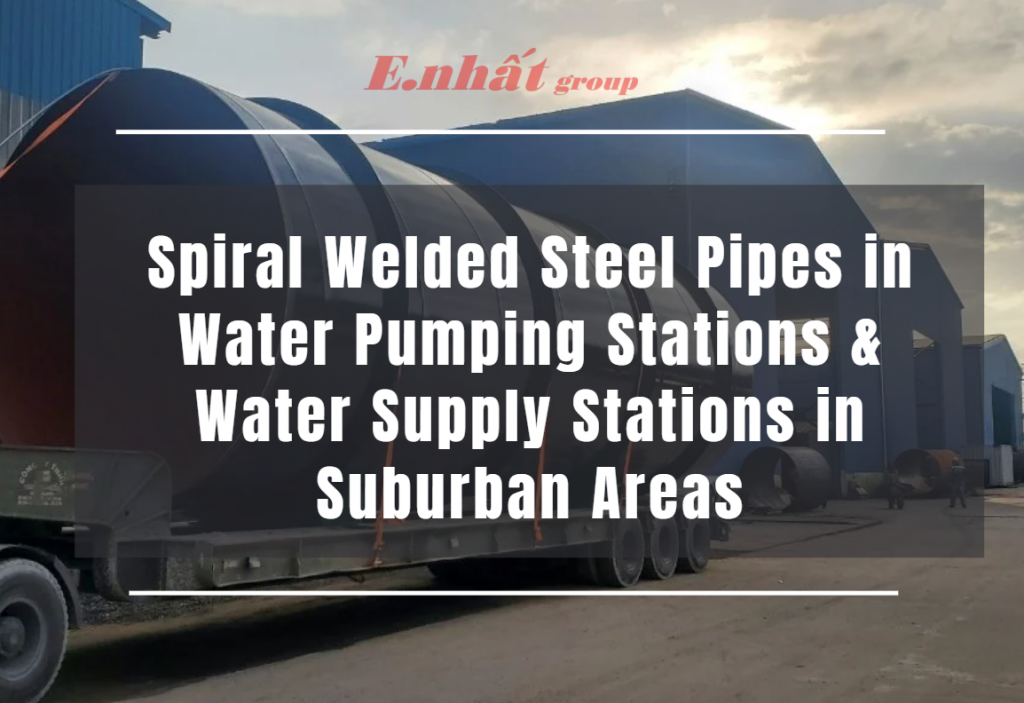
E.NHAT Group produces spiral welded steel pipes (SSAW) for suction/discharge pipes of pumping stations and transmission lines in coastal areas: durable, watertight, diverse coatings, nationwide delivery.
Overview
In water pumping stations and water supply stations in rural areas, the pipe network often has to overcome many complex conditions: narrow terrain, weak soil, canals, road intersections, humid or corrosive environments. Spiral welded steel pipe (SSAW) is an effective choice thanks to its high mechanical strength, continuous spiral weld, long lengths to reduce joints, and the ability to customize the coating according to the actual environment.
Why is spiral welded steel pipe suitable for pumping stations & suburban areas?
- Watertight & pressure resistant: continuous spiral weld, strict quality control; when constructing, use butt welding and/or flange connection at the equipment location.
- Cost-effective in the medium-large diameter range: spiral welded steel pipes help optimize costs for transmission lines and large-diameter suction/discharge pipes.
- Customizable according to design: diameter, thickness, length of the tree, connector (beveled welding/flange), inner-outer coating can be configured according to technical documents.
- Rich coating: Epoxy/FBE, PU, bitumen (outside the pipe); Epoxy/PU or cement mortar (inside the pipe) – suitable for underground, riverside, coastal environments.
- Convenient construction: 6-12 m tree reduces joints; flanges/flexible joints are arranged at points that need to be disassembled or anti-vibration near the pump – valve.
Typical applications of spiral welded steel pipes
In the water pumping station
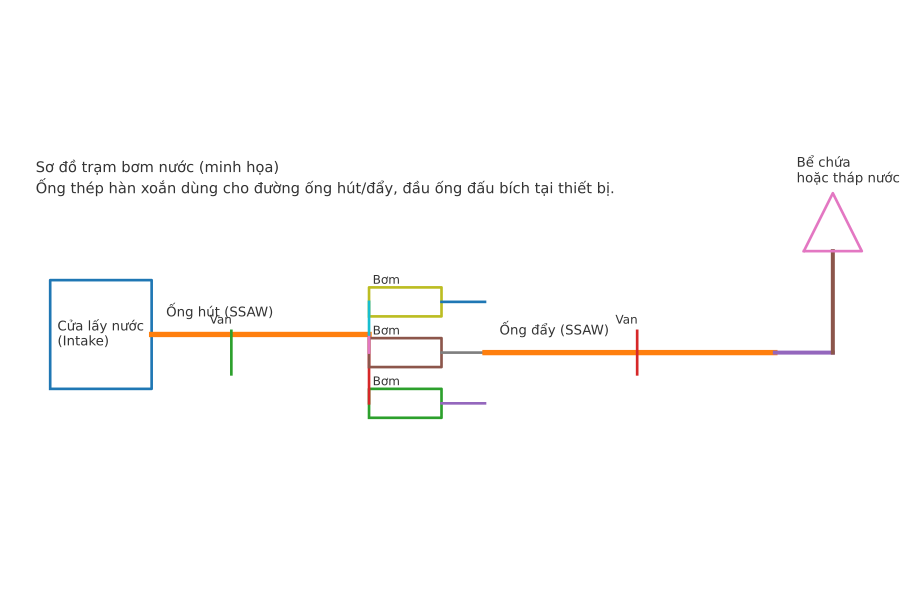
- Suction & discharge pipes: spiral welded steel pipes for large DN range, good watertightness and stiffness; flanged pipe ends at pumps, valves, flow meters for maintenance.
- Header: use spiral welded steel pipes for suction/discharge, reduce hydraulic loss (when combined with Epoxy lining or cement mortar).
- Vibration reduction: combine flexible joints, bearings, and hangers with the right specifications in the pump area.
In the suburban water supply station
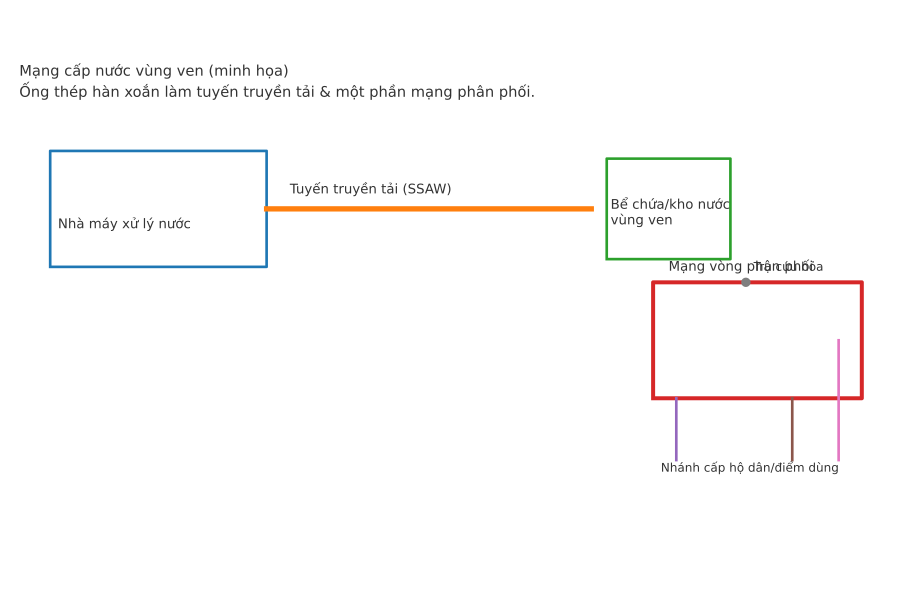
- Transmission line: spiral welded steel pipe carries water from the source/treatment plant to the tank, water tower or residential distribution network. Spiral welded steel pipe is suitable for crossing points (canals, ditches, major roads).
- Main network & branch: use spiral welded steel pipe with diameter in medium range, combined with flange connection at the sectional valve, main meter, fire hydrant.
- Corrosion protection: choose Epoxy/FBE/PU/bitumen (outside), Epoxy/PU/cement mortar (inside) depending on soil, groundwater, salinity.
Technical configuration (for reference)
Below is the initial suggestion, E.NHAT Group will adjust the spiral welded steel pipe according to the flow – pressure – geology – route of each project.
- Diameter range
- Pump station suction/discharge pipes: DN300–DN1200 (according to design).
- Suburban transmission lines: DN400–DN2000 (according to demand).
- Main ring/branch network: DN150–DN800 (depending on area).
- Thickness of spiral welded steel pipe: choose according to working pressure, safety factor and applicable standards.
- Length of SSAW pipe: 6 m, 12 m or as ordered.
- Connector: beveled welding for field joints; flange connection at equipment/valve/meter for convenient installation and maintenance.
- Outer coating for spiral welded steel pipe: Epoxy/FBE/PU/bitumen (buried underground, submerged).
- Inner coating for spiral welded steel pipe: Epoxy/PU or cement mortar (reducing friction, anti-corrosion).
- Synchronous accessories for spiral welded steel pipe: steel flange, cone, elbow, tee, flange blind, pipe holder, support ring, branch pipe for fire hydrant.
📌 READ MORE: Spiral Welded Steel Pipe For Fire Protection System – Durable, Watertight, Cost-Optimized | E.NHAT
📌 READ MORE: Spiral Welded Steel Pipes in Wind Power & Renewable Energy Projects
E.NHAT GROUP’s quality process
- Manufacturer since 1989 (~35 years of experience): E.NHAT proactively manages resources, ensuring progress – quality – cost.
- Production capacity of spiral welded steel pipes up to ~180,000 tons/year: ready to meet large projects, nationwide delivery.
- Multi-step quality control: size/roundness inspection; NDT according to project requirements; surface cleaning; painting/coating; thickness – adhesion inspection; packaging – batch labeling.
- Complete documents: CO – CQ, transportation and storage procedures, installation instructions – acceptance of spiral welded steel pipes.
📌 READ MORE: E.NHAT’s Production Capacity – A Solid Foundation For High Quality Spiral Welded Steel Pipes
E.NHAT’s Production Capacity – A Solid Foundation For High Quality Spiral Welded Steel Pipes

Construction & acceptance of spiral welded steel pipes
- Trenching – ground treatment: sand cushion/concrete lining according to geology.
- Installation: alignment – elevation – slope; butt welding, flange connection at equipment/valve points.
- Local painting: coating treatment at on-site welds according to approved paint system.
- Tightness/pressure testing: according to design standards/documents.
- Backfilling – protection: placing warning tape (if applicable), positioning and completion markers.
📝 Checklist of information for quick consultation from E.NHAT
- Design flow – pressure, length & route diagram.
- Geological – hydrological conditions (humidity, salinity, corrosion).
- Acceptance criteria/standard requirements, desired coating options.
- Construction conditions – logistics (access, turning radius, crane).
- Project progress, need for segmentation by valve/flange.
Need to configure suction/discharge piping for a pump station or suburban transmission line?
Contact E.NHAT to receive technical solutions & quick quotes for spiral welded steel pipes, optimize coating according to actual geology, synchronize accessories and support acceptance documents.
Consulting – Quotation – Supply Spiral Welded Steel Pipe
SEE MORE ARTICLES ABOUT SPIRAL WELDED STEEL PIPE
OUR PROJECTS