

 VN
Learn about spiral welded steel pipes (SSAW/HSAW), SAW/DSAW process, AWWA, API 5L, JIS, DNV standards, NDT testing and practical applications.
1) What is spiral welded steel pipe?
Spiral welded steel pipe (SSAW/HSAW – spiral/helical submerged arc welded pipe) is formed from coiled steel strip, bent into a spiral and welded along that spiral; different from LSAW which is welded along a straight longitudinal line. The spiral weld structure allows flexible production in terms of diameter, effectively utilizing the steel strip width.
In practice, SSAW pipes often use submerged arc welding (SAW) – welding in a protective layer of flux – to complete the weld inside and outside the pipe (DSAW).
2) Submerged arc welding (SAW/DSAW) – principles and characteristics
SAW creates an arc between the bare wire and the workpiece, the entire arc is under the flux layer so no shielding gas is needed; the flux creates slag, gas, adds alloy and is recovered for reuse. This method provides high deposition rate, stable weld quality, suitable for large pipes. DSAW is a variation using two welding passes (inside & outside).
TIG, MIG, manual arc, submerged arc welding – Advantages in spiral welded steel pipe manufacturing
3) )Spiral welded steel pipe manufacturing process (general description)
- Forming & tack-welding: The steel strip is bent in a spiral line; the first stage can be separated by high-speed forming and continuous tack welding.
- SAW finishing welding: The second stage performs submerged arc welding to complete the weld, which can be in a 2-stage configuration to improve productivity and quality.
- Adjustment – inspection – straightening – edge rounding – protective coating.
The 2-stage line model (separate forming and finishing welding) is a popular industrial solution today. -
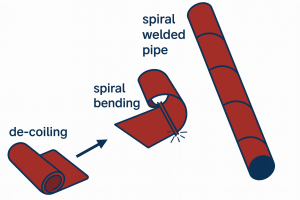
Illustration: Spiral welded steel pipe production process
4) Important applicable standards
- AWWA C200 (Water Supply): Allows spirally welded or longitudinally welded steel pipes of DN150 and above for water transmission & distribution, raw water, recycled water and wastewater systems.
- API 5L (Oil & Gas Pipeline): Specifies pipe (seamless & welded). PSL2 has more stringent requirements for impact strength, components, and non-destructive testing (NDT).
- DNV-ST-F101 (Subsea Pipeline): International framework for the design, manufacture, and operation of subsea pipelines, focusing on structural integrity.
- JIS G 3443 (pipes – coatings for water supply):
- Part 3 (2020): Durable external plastic coating for pipes used in water supply, drainage, industry and agriculture.
- Part 4: Internal epoxy coating (for clean water service, anti-corrosion).
Note: In API 5L, the common practical terminology is SSAW/HSAW for spiral pipe, LSAW/SAWL for longitudinally welded pipe; NDT (UT/RT…) is mandatory for many PSL2 items.
🔖 As a spiral welded steel pipe manufacturer, E.NHAT Group owns a full set of JIS G 3443 certificates for the field of water supply and drainage and industry, ensuring the capacity to design, manufacture, control quality and prevent corrosion according to Japanese standards.
📌 READ MORE: JAPANESE STANDARD (JIS) FOR SPIRAL WELDED STEEL PIPE – INTERNATIONAL QUALITY FOR EVERY PROJECT
5) Quality Control/Audit (QC/QA)
- Hydraulic test: Check tightness & pressure resistance (required/declared in API 5L).
- NDT for welded pipes: PSL2 (API 5L): NDT required; usually ultrasonic (UT) for pipe body and UT or radiography (RT) for weld. Level/provision depends on diameter, thickness, steel grade.
- Check dimensions, burrs, chamfers, straightness, geometrical errors according to each applicable standard (AWWA/API/JIS…).
COMPARISON OF 2 NON-DESTRUCTIVE TESTING METHODS: MAGNETIC (MT) AND ULTRASONIC (UT)
6) Typical applications of spiral welded steel pipes
- Clean water, raw water, wastewater transmission: apply AWWA C200; combine with AWWA C206 field welding standard when constructing ring joints.
- Onshore/offshore oil and gas pipelines: according to API 5L; for subsea lines, refer to DNV-ST-F101.
- Pipe piles, structures, heat-conditioning-industrial pipes: depending on the technical requirements of each project, SSAW can be prioritized due to its flexibility in diameter and cost. (Overview of characteristics & production advantages).
📌See more articles about spiral welded steel pipe applications below:
7) Advantages and disadvantages: Spiral welded steel pipe (SSAW) compared to LSAW/ERW
SSAW Advantages
Flexible production of diameters from one steel strip width; material efficient. High productivity with automatic SAW/DSAW; suitable for large diameter pipes.
Technical Note
Some industry sources suggest that residual stress and fatigue properties may differ with LSAW; pipe type selection should be based on specific design criteria and operating conditions (pressure, environment, fatigue loading).
Compare to ERW
ERW is generally applied for small-medium diameter pipes; SSAW is suitable for large diameters, spiral weld has manufacturing advantages but the final decision depends on standard/service requirements.
8) Coatings – corrosion protection (common examples)
📌 SEE MORE: Spiral Welded Steel Pipe: Guide to Choosing Epoxy, Polyurethane, Bitumen or Cement Coating
9) Chechnical checklist when ordering spiral welded steel pipes
- Applicable standards: AWWA C200 (water) or API 5L (oil and gas) + related standards (AWWA C206 for field welding, DNV-ST-F101 if subsea, JIS G 3443 for water coating).
- Steel grade – PSL – mechanical properties: according to API 5L/TC of AWWA; determine impact requirements (PSL2), CE, strength.
- Dimensions – tolerances – chamfers – lengths.
- NDT & pressure testing: specify UT/RT for welds, hydraulic tests, acceptance levels.
- Coating & corrosion control: specify standards & adhesion conditions/film thickness.
10) Frequently Asked Questions about SSAW pipes (FAQ)
Consulting – Quotation – Supply Spiral Welded Steel Pipe
SEE MORE ARTICLES ABOUT SPIRAL WELDED STEEL PIPE