

 VN

Spiral welded steel pipe solutions for wind and solar power projects: underground cable protection, drainage, casing, anti-corrosion coating, standards.
Quick summary
In wind power and renewable energy projects, spiral welded steel pipes (SSAW) are the optimal choice for auxiliary infrastructure: protecting electric cables – optical cables, round sewers for public roads, casing pipes for foundations – monitoring towers – transformer stations, and crossings over roads, streams, and embankments. Advantages: large diameter, high ring stiffness, length of 6-12 m, easy to transport – install, reasonable cost and many anti-corrosion coating options.
Why use spiral welded steel pipes for renewable energy infrastructure?
- Outstanding ring diameter and stiffness
Spiral welded steel pipes can be produced with very large diameters (DN300–DN2600+), with various wall thicknesses, helping to withstand ground cover loads – vehicle loads on internal roads and station areas. The spiral weld structure is evenly distributed around the pipe body to help disperse stress well. - Standard length, optimized progress
Spiral welded steel pipes with lengths of 6-12 m reduce the number of joints, shortening installation time in remote, difficult-to-access terrain conditions of wind and solar power projects. - Multi-purpose compatibility
From cable protection conduit, round drainage culverts, to casing for auxiliary foundations, spiral welded steel pipe meets many items in a project – reducing supply risk, simplifying material management. - Reasonable cost of ownership
Compared with bulky prefabricated structural solutions, spiral welded steel pipes are easy to transport in modules, quick to assemble, reducing labor costs and time occupying construction site.
📌 READ MORE: Installation of Spiral Welded Steel Pipes in Mountains and Weak Ground: Practical Guide
Typical applications of spiral welded steel pipes according to each type of project
1) Onshore wind power
- Underground cable protection pipe (power & fiber): spiral welded steel pipe is used when pulling cables through areas that need mechanical protection (roads, drainage ditches, weak ground). Spiral welded steel pipe creates “armor” against compression, sharp rocks, and dynamic loads.
Crossing diagram of spiral welded steel pipe to protect underground cables through roads/ditches. (Note: At the intersection, flared head + sleeve should be used to reduce stress concentration, restore the coating with heat shrink sleeve)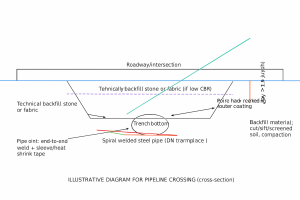
- Round culverts & public road drainage: large diameter spiral welded steel pipes, thick walls, good load-bearing capacity; can be coated with bitumen/epoxy/3LPE to increase service life.
- Casing pipes for auxiliary foundations: camera pillars, wind monitoring pillars, fence infrastructure, auxiliary equipment foundations around the station.
- Temporary conduit and discharge pipes during construction: serving organic stripping, lowering local water levels, or draining water for washing the surface.
2) Offshore wind power (nearshore/landfall & onshore infrastructure)
- Landfall cable protection: the transition from the shore to the station; spiral welded steel pipes as sleeves/waiting pipes help protect the cables from erosion and impact.
- Crossing through existing infrastructure: steel pipes used as covers when pulling cables through roads/dykes/embankments – limit excavation, reduce risks.
Notes: Spiral welded steel pipes are recommended for auxiliary infrastructure; main structures such as tower body and main foundation are usually designed according to the project’s own standards.
3) Spiral Welded Steel Pipes in Wind Power & Renewable Energy Projects (solar farm)
- Circular culvert – solar yard drainage: spiral welded steel pipe supports rainwater drainage, limits ground erosion.
- Cable sleeve at intersection: protects DC/AC cables, optical cables when passing through internal roads, ditches.
- Solar panel cleaning water supply infrastructure (depending on the project): spiral steel pipe lined with cement mortar for technical water.
Standards and recommended anti-corrosion coatings
📍 Pipes & Tubes:
- API 5L (Gr. B, X42–X60): conduit & cable sheathing.
- ASTM A252: pile pipe, casing pipe.
- AWWA C200: steel pipe for water pipes (when used as sewer/conduit).
📍 Outer coating for spiral welded steel pipes (depending on the environment – soil, humidity, salt spray, near the sea):
- FBE (Fusion-Bonded Epoxy), 3LPE/3LPP, Epoxy 2-component, bitum as per AWWA C210/C213/C218, ISO 21809, ISO 12944.
- Coastal/saltwater areas: prioritize 3LPE/3LPP system or multi-layer epoxy-polyurethane.
📍Inner lining (when conducting technical water/drainage): Cement mortar lining according to AWWA or epoxy inner lining for corrosive environments.
📍Quality control: Pressure test, ultrasonic welding/100% welding lap, size – roundness check, coating holiday test.
Suggestions for design and installation of spiral welded steel pipes for quick construction and long lasting durability
- Joints: butt welding/flange/sleeve depending on location. The crossing section should use flared ends or sleeves to reduce stress concentration.
- Cushion & burial: spread a layer of fine sand/gravel under the pipe, fill each layer – compact evenly on both sides of the pipe wall.
- Protect the pipe end: use a cap to prevent soil – water – sand while waiting for the cable to be pulled.
- Anti-corrosion at the joint: after welding, restore the coating with heat shrink tape, heat shrink sleeve or field coating compatible with the original coating system.
- Synchronized documents: shop-drawing, welding process, WPS/PQR, coating inspection checklist – acceptance before filling.
Reference range of commonly used sizes & materials
- Nominal diameter: DN300–DN2600 (depending on purpose: cable, culvert, casing).
- Thickness: ~6–20 mm (choose according to soil cover load, water flow, span length).
- Steel grade: Q235B/SS400/S355J2 or API 5L Gr.B – X42 – X60.
- Bar length: 6–12 m; can be cut according to construction site requirements.
The final design requires detailed calculations of loads, geology, water levels and technical requirements of each project.
Benefits of choosing an experienced spiral welded steel pipe manufacturer
- Production to order: correct size – steel grade – coating.
- Testing & certification capabilities: full quality records, traceability of steel coils – production lines.
- Logistics & delivery along project routes: scratch-resistant coating packaging, end caps, clear labels.
- Site technical advice: recommended pipe configuration – fittings – connection options to shorten the progress.
Why work with E.NHAT?
- Over 30 years of experience in manufacturing spiral welded steel pipes and has accompanied many large projects nationwide.
- Customized consulting according to project goals: lifespan, progress, budget and local regulations.
- Full service: from configuration proposal, testing samples, to quality control and handover documents.
📌 READ MORE: E.NHAT’s Production Capacity – A Solid Foundation For High Quality Spiral Welded Steel Pipes
E.NHAT’s Production Capacity – A Solid Foundation For High Quality Spiral Welded Steel Pipes
Consulting – Quotation – Supply Spiral Welded Steel Pipe
SEE MORE ARTICLES ABOUT SPIRAL WELDED STEEL PIPE