

 VN

Instructions for constructing spiral welded steel pipes through hills and weak soil: survey, foundation reinforcement, coating, pressure testing, erosion control – complete and accurate
Why is spiral welded steel pipe suitable for complex terrain?
In pipelines passing through hills, slopes, valleys or weak ground areas (mud, peat, soft clay…), the greatest requirements are durability – tightness – ability to adapt to ground deformation. Spiral welded steel pipes (SSAW) are outstanding thanks to:
- Good mechanical properties, resistant to bending – tension – compression, suitable for locations requiring direction change or slope change.
- Large pipe length, evenly distributed spiral welds help disperse stress.
- Spiral welded steel pipes are easy to customize in thickness, large diameter, convenient for high flow in water supply, stormwater drainage, flood drainage or technical water supply projects.
- Diverse protective coatings (epoxy, polyurethane, anti-floating concrete coating…) help control corrosion, erosion and buoyancy in water-saturated soil.
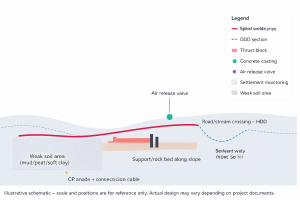
1) Survey and design of pipelines on steep hills and weak soil
- Detailed topographic and geological survey: topographic measurement – longitudinal profile, survey drilling, field testing (SPT/CPT) to determine deformation modulus, bearing capacity, groundwater level and landslide risk.
- Route optimization:
- Reduce bend radius too small to limit internal forces; use elbows, joints or offset welds according to design.
- Avoid landslides and gully erosion, prioritize stable slopes and hard geological ridges.
- Reasonable anchorage and support segmentation: Install thrust blocks at elbows, tees, and valves; support beams at slopes to control longitudinal sliding.
- Calculation of differential settlement in weak soil: specifying expansion joints, expansion compensation rings, and appropriate field welding length to disperse deformation.
2) Foundation solutions in weak soil areas
- Foundation reinforcement and improvement:
- Spread geotextile, geogrid combined with sand cushion layer to increase shear resistance and load distribution.
- Sand piles, preloading + permeable drains, cement-soil piles (CDM) or jet grouting for large settlement areas.
- Place pipes on supporting structures: concrete beams, pile foundations, abutments – local support pillars through thick peat areas or swampy pits.
- Buoyancy & Stabilization: Where water tables are high, consider concrete weight coating or ground anchors to resist buoyancy.
3) Construction over slopes, streams, and intersections
- Digging trenches in steps (sloping hills): creating a terraced ground, building embankments, gabions/ripraps to prevent erosion; 10-20 cm sand cushion at the bottom of the trench, controlling the elevation – slope according to the design longitudinal profile.
- Drilling jacks/directional drilling (HDD): at intersections of roads, streams, canals… to avoid subsidence and reduce surface impact.
- Suspended pipes/bridge pipes: using steel – concrete supports, elastic bearings, expansion joints when having to cross deep ravines or flood drainage ditches.
- Construction drainage: temporary drainage ditches, pumps to lower water levels, anti-mud BMPs (settling tanks, filter cloths) to control rain and flood erosion.
📌 READ MORE: HDD North America Cross River Pipeline Project – When Strength and Flexibility are the Decisive Factors
Spiral welded steel pipes – An indispensable piece in global infrastructure projects
4) Coating selection – corrosion protection for spiral welded steel pipes
- Outer lining & coating of spiral welded steel pipes: solvent/solvent-free epoxy, FBE, polyurethane (PU); where the soil and rocks are sharp, mechanical protection should be added (fiber cement mortar, HDPE coating, reinforced glass fabric).
- Inner lining of spiral steel pipes: cement mortar (for clean water/drainage) or specialized anti-abrasion epoxy/PU, suitable for high current speeds.
- Cathodic protection (CP): sacrificial anode or forced current source in areas with good conductive soil, with risk of leakage current.
- Anti-floating concrete coating for spiral welded steel pipes in flooded areas according to buoyancy force – adhesion force calculation.
(When preparing technical documents, refer to specialized standards such as AWWA C200 for steel pipes, AWWA C206 for field welding, AWWA C210/C222 for coatings and AWWA M11 Design Manual. Depending on the project, apply current national/provincial standards.)
5) Construction process & quality control of spiral welded steel pipes
- Processing – transportation: standard pipe burning (usually 6–12 m), dust-proof end caps; use rollers/wooden pads when sliding on slopes.
- Field welding: according to approved WPS/PQR; check clearance, concentricity; use SMAW/FCAW/GMAW according to windy and humid conditions in mountainous areas.
- NDT of welds: ultrasonic/RT, surface inspection (VT/PT/MT), acceptance according to specified quality levels.
- Coating inspection: dry thickness measurement (DFT), holiday test, paint repair at outer ring welds.
- Pipe placement – padding – groove filling: sand/fine stone padding, compacting both sides of the pipe in thin layers; avoid impacts creating “hard spots”.
- Pressure testing – flushing: hydraulic pressure testing according to design pressure; flushing, washing (possibly pigging) until reaching the specified cleanliness; leak testing at valves and joints.
- Restoring the ground: planting grass/bursh mat to prevent erosion, drainage ditches along the route, and signs to manage the pipeline corridor.
📌 READ MORE: Pressure Testing Methods in the Production of Spiral Welded Steel Pipes
Pressure Testing Methods in the Production of Spiral Welded Steel Pipes
6) Common Risk Management & Prevention
- Slope landslide after heavy rain → monitor slope cracks, add soft revetment/rock gabion revetment, reduce slope load.
- Differential settlement causes weld cracks → arrange intermediate supports, expansion compensation rings; increase settlement monitoring frequency in the first 3-6 months.
- Local corrosion at the erosion location → mechanical protection cushion, increase cover thickness, CP; periodically check the protection voltage.
- Stream erosion across the pipeline → lower the underground level, prevent erosion of abutments – pillars, add rock gabions/riprap.
7) Quick Checklist for Spiral Welded Steel Pipe Project in Difficult Terrain
Full geological and hydrological survey report of key locations.
Construction organization drawing has HDD/underground jacking plan at intersections.
Explain differential settlement, buoyancy, thrust block, pipe anchor.
WPS/PQR, NDT, DFT, holiday test, pressure test – flushing process.
Quarterly CP planning and voltage testing.
BMP measures against mud and temporary drainage during rainy season.
Subsidence – erosion – corrosion monitoring plan after operation.
Conclusion
Construction of spiral welded steel pipes through hills and weak soil requires a total solution package: reasonable route design – foundation reinforcement – environmental coating & CP – strict welding/NDT process – erosion/settlement control. Synchronously implementing the above steps helps increase the pipeline life, reduce the risk of incidents and optimize life-cycle maintenance costs.
Why work with E.NHAT?
- Over 30 years of experience in manufacturing spiral welded steel pipes and has accompanied many large projects nationwide.
- Customized consulting according to project goals: lifespan, progress, budget and local regulations.
- Full service: from configuration proposal, testing samples, to quality control and handover documents.
📌 XEM THÊM: E.NHAT’s Production Capacity – A Solid Foundation For High Quality Spiral Welded Steel Pipes
E.NHAT’s Production Capacity – A Solid Foundation For High Quality Spiral Welded Steel Pipes
Consulting – Quotation – Supply Spiral Welded Steel Pipe
SEE MORE ARTICLES ABOUT SPIRAL WELDED STEEL PIPE