

 VN
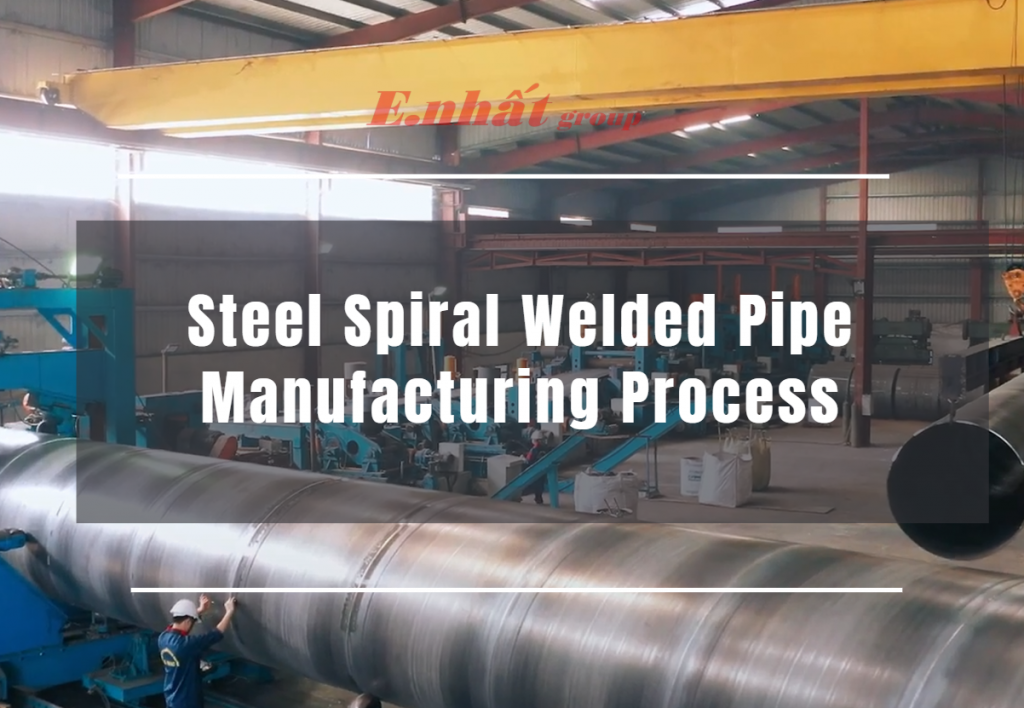
Learn about the production process of spiral welded steel pipes (SSAW) from steel coil to finished product: API 5L/ISO 3183, AWWA C200 standards, NDT testing, hydraulic testing, and 3LPE coating.
Spiral Submerged-Arc Welded (SSAW) steel pipes are made by coiling steel strips at a defined spiral angle, then welding them along the spiral using submerged arc welding (SAW) technology from both the inside and outside. This pipe manufacturing method allows for the production of large diameters from narrow steel strips, suitable for water, gas, oil pipelines, and water supply and drainage infrastructure.
Commonly applicable standards
- API 5L / ISO 3183: Regulations specifying the requirements for manufacturing and classifying PSL1/PSL2 pipes for oil and gas pipelines. (seamless & welded).
- AWWA C200: Standard straight steel pipes/spiral welded steel pipes for transmission of clean water, raw water, and wastewater ≥150 mm.
Note: Water projects typically refer to AWWA C200 in conjunction with AWWA M11 design guidelines; oil and gas pipelines typically refer to API 5L/ISO 3183 with additional requirements from the client.
Furthermore, E.NHẤT also possesses many prestigious international certifications such as JIS G 3443 (Japan), ANSI/AWWA (USA), BS EN 1092-1 (Europe), and a Science & Technology Enterprise Certificate, affirming its capacity to produce standard spiral welded steel pipes for both oil and gas and water supply and drainage projects.
📌 READ MORE: Certificates of E.NHAT Industrial Joint Stock Company
Spiral welded steel pipe manufacturing process
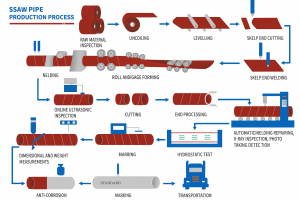
1. Raw Material Inspection
The entire steel coil is inspected for origin, certification, mechanical properties, chemical composition, and surface finish to ensure it meets the required technical standards.
2. Uncoiling
The steel coil is fed into a unwinding machine, separating it into strips of steel in preparation for further processing.
3. Levelling
The steel strip passes through a system of straightening rollers, eliminating warping and deformation, and stabilizing its geometry before shaping.
4. Skelp End Cutting
The end of the roll is cut off to ensure a straight, clean edge, facilitating the welding process.
5. Skelp End Welding
Weld the end of the previous steel coil to the beginning of the next coil to ensure continuous, uninterrupted operation of the production line.
6. Roll and Cage Forming
The steel strip is bent into a spiral cylinder using roller systems and a forming unit, according to a predetermined spiral angle.
7. Welding
Submerged arc welding (SAW) is performed from both the inside and outside surfaces in a continuous spiral pattern, ensuring a strong and durable weld.
📌 READ MORE: Spiral Welded Steel Pipes and Submerged Arc Welding Technology: Technical Overview & Applications
8. Online Ultrasonic Inspection
The ultrasonic probe system scans 100% of the weld length directly on the production line, detecting internal defects.
9. Cutting
The finished pipes are cut to the required order length using an automatic cutting machine.
10. End Processing
Perform beveling, cleaning, and preparing the pipe ends for on-site assembly or welding.
11. Automatic welding, weld repair, X-ray inspection, photographic inspection.
The welds are automatically repaired if defects are detected; some critical areas are inspected using X-rays and the images are recorded for quality documentation.
12. Hydrostatic Test
High-pressure water is pumped into the pipe to test its tightness and durability, ensuring that the pipe will not leak during operation.
13. Dimensional and Weight Measurements
Inspect the diameter, thickness, roundness, length, and weight of the pipe to ensure they meet the drawing requirements and standards.
14. Anti-Corrosion
Depending on project requirements, the pipes are galvanized or coated with protective layers such as 3LPE, epoxy, or bitumen to prevent corrosion.
📌 READ MORE: Spiral Welded Steel Pipe: Guide to Choosing Epoxy, Polyurethane, Bitumen or Cement Coating
15. Marking
Print product information such as manufacturing standards, dimensions, batch code, and production date onto the pipe body.
16. Transportation
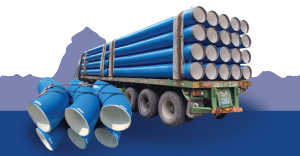
The pipes are bundled, packaged, or placed on specialized racks for safe transport to the customer’s construction site or warehouse.
Typical testing and inspection
- UT/X-ray for spiral welds: with flammable liquids/gases, 100% weld length inspection is usually required; with water/non-flammable environments, sampling according to project standards may be acceptable.
- Post-form hydraulic testing is performed to confirm tightness and durability. (Referenced standards include AWWA C200, API 5L/ISO 3183)
- Check dimensions/geometry: OD, thickness, roundness, weld misalignment, curvature.
Protective coating for spiral welded steel pipes
To ensure durability and corrosion resistance, E.NHẤT’s spiral welded steel pipes are coated with internationally standardized coating systems, tailored to each environment and project requirement.
📌 READ MORE: Spiral Welded Steel Pipe: Guide to Choosing Epoxy, Polyurethane, Bitumen or Cement Coating
Why are spiral welded steel pipes suitable for large construction projects?
- Large diameter production with narrow steel strip → optimized material costs.
- Double-sided SAW line + online NDT enables quality control right on the line.
- Easily customizable length, standard, and coating to project requirements (API/ISO/AWWA + ISO 21809-1).
📌 See more articles about the applications of spiral welded steel pipes below:
Consultation – Quotation – Supply of Spiral Welded Steel Pipe
E.NHẤT GROUP specializes in:
👉 Contact us now for consultation and the latest price quote for spiral welded steel pipes!