

 VN

From a technical perspective, let’s learn about bitumen coating for spiral welded steel pipes with E.NHAT: advantages, hot-applied process, standards AWWA C203, DIN 30673, BS 534, legal notes PAH/REACH and comparison with Epoxy/FBE/3LPE.
Quick summary: Bituminous coatings (comprising coal-tar enamel according to AWWA C203 and petroleum bitumen according to DIN 30673) are economical “armoring” for buried pipelines. For a durable coating, proper surface preparation (ISO 8501-1 – Sa 2½), hot fusion application and a holiday test according to NACE SP0188 are required before acceptance.
What is bitumen coated spiral welded steel pipe?
Spiral welded steel pipe (SSAW) is made from coiled steel plate and submerged arc welded in a spiral. When operating in wet soil/aggressive environments, the pipe is often coated with bitumen/bituminous enamel (or coal-tar enamel) to prevent surface corrosion. In terms of standards, the two common “streams” are:
- DIN 30673 – Specification for bituminous coating/lining for spiral welded steel pipes and fittings (petroleum bitumen).
- AWWA C203 –coal-tar enamel & hot melt tape/tape specification for water supply steel pipes (hot-applied).
The concept of “bitumen coating” in the market practice often includes both petroleum bitumen (DIN 30673) and coal-tar enamel (AWWA C203). Depending on the project requirements, the investor/design consultant will decide on the correct “system” and applicable standards.
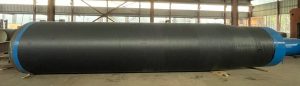
Why choose bitumen coating for SSAW pipes?
- Economical corrosion barrier: The enamel/bitumen layer creates an “armor” that insulates the steel surface from moisture/ion attack, extending the life of buried pipes at a reasonable investment cost. AWWA C203 states that the purpose of the molten coal-tar system is to provide external (and possibly internal) protection for buried/semi-exposed steel water pipes.
- Suitable for buried/underwater applications: The bitumen/coal-tar enamel system has a long history of use in large-scale water supply pipes (since the 1940s).
- Easy to repair on site: At joints/impact points, it is possible to heat patch or use molten bitumen tape according to standard instructions.
Standards framework – choosing the right technical “language”

- AWWA C203 (2020/2008/1978…): Material requirements, construction, acceptance for coal-tar enamel + hot-applied reinforcing tape for water supply; includes a section on testing/inspection & delivery.
- DIN 30673: German standard for petroleum bitumen for external and/or internal coating/lining of spiral-welded steel pipes, specifying surface conditions, primer requirements, bitumen compounds, fillers, thickness and defect-free finish.
- BS 534:1990: British standard for spiral-welded steel pipes for water & wastewater, including external/internal corrosion protection; with reference to hot-pressure bitumen materials (BS 4147).
- Some manufacturers/contractors also note that the surface is cleaned to Sa 2½ (as per SIS 055900/ISO 8501-1) before coating – a common practice in anti-corrosion applications.
Structure of a bitumen coating system (typical)
According to the logic of AWWA C203/DIN 30673, the bitumen coating system used for spiral welded steel pipes usually includes:
- Surface cleaning (blasting to the specified cleanliness),
- Primer to increase adhesion
- Hot-melt enamel (coal-tar enamel or bitumen petroleum) – the main layer to create a moisture/ion barrier,
- Reinforcement with cloth/tape (glass cloth/reinforcement tape) when required,
- Outer protection (outerwrap) to prevent impact & marks during transportation and installation of spiral welded steel pipes.
At the construction site, the lap/end weld will be additionally coated with compatible enamel/hot melt tape, then gap tested/“holiday test” and thickness measured for acceptance.
Spiral welded steel pipe construction process
- Surface preparation: remove rust, impurities; achieve required cleanliness & roughness to increase adhesion.
- Heating & coating: with coal-tar/bitumen hot-applied, the compound is heated to the appropriate viscosity and then coated/poured/wrapped; the reinforcing tape is wrapped concentrically to ensure overlap.
- Inspection & repair: measure thickness, check pinholes (holiday); defects are patched with hot enamel or bitumen tape according to standards, ensuring continuous coating.
When is bitumen coating a reasonable choice for spiral welded steel pipe?
-
Buried water/sewer pipelines in neutral-slightly aggressive soil environments, requiring optimal life-cycle costs.
-
Rehabilitation projects: convenient patching and off-site reinforcement, no need for long heating lines like some modern coating systems.
-
Normal “clean water” operating temperature: AWWA C203 recommends consulting the manufacturer if the operating temperature is higher than normal drinking water.
Safety, health & legal notice (very important)
-
Coal-tar pitch (CTPHT) – the binder in coal-tar enamel – is classified as carcinogenic/mutagenic by the EU; some REACH restrictions are being strengthened for PAHs. This trend has led many developers in Europe to move away from coal-tar and towards Epoxy/FBE/3LPE/PU systems in some applications.
-
If the project requires contact with drinking water or is located in an area with strict environmental regulations, local legal requirements should be checked before choosing a coal-tar/bitumen system, and alternative coating systems with equivalent performance and hygiene certification should be considered.
Quick Comparison: Bitumen/Coal-tar and Modern Systems
|
Criteria |
Bitumen/Coal-tar (DIN 30673/AWWA C203) | Epoxy/FBE/3LPE (AWWA C210/C222, ISO 21809…) |
| Purpose | Economical anti-corrosion for buried pipes, easy to patch on site |
High strength, good chemical/impact resistance, consistent quality control |
|
Construction |
Hot-applied, heating element; reinforcing tape | Spraying/extrusion/film forming on line; good control of thickness and defects |
| Legal/VSMT | CTE is subject to tightening regulations in the EU due to PAHs |
Tar-free trend, multiple drinking water certifications |
|
Economic |
Low investment cost |
Higher cost but good longevity/stability |
(The representative standards stated for orientation and system selection must follow the bidding documents/local standards.)
📌 Read more: Epoxy Coated Spiral Welded Steel Pipe – High Grade Anti-Corrosion
Applications and practical examples
- Urban water supply, irrigation, buried industrial pipes; many international projects previously used coal-tar enamel according to AWWA C203 (standardized since 1940).
- Some pipe coaters still supply bitumen/coal-tar (with reinforcing tape) according to DIN 30673/AWWA for markets that have not yet tightened tar.
Implementation advice
- Right from the HSMT/design stage, clearly define the bitumen/coal-tar system and the applicable standard (DIN 30673 or AWWA C203).
- For drinking water projects or markets where PAH is tightening, consider Epoxy/FBE/3LPE for spiral welded steel pipes to facilitate hygiene certification and legal compliance.
Consulting – Quotation – Supply Spiral Welded Steel Pipe
SEE MORE ARTICLES ABOUT SPIRAL WELDED STEEL PIPE