

 VN
VN
Learn in detail about four popular welding methods: TIG, MIG, manual arc, submerged arc in the production of spiral welded steel pipes. Advantages and disadvantages of each method, practical applications and advice on choosing the right technology.
In the manufacturing and construction industry, spiral welded steel pipes are indispensable materials in water and gas pipeline systems, infrastructure, bridges and roads… One of the factors that determine the quality of steel pipes is welding technology. Currently, the three most popular welding methods applied are: TIG welding, MIG welding and manual arc welding.
So what are the advantages and disadvantages of each method? Which method is most suitable for the production of spiral welded steel pipes? The following article will analyze in detail to help you have the most complete and accurate perspective.
1. Overview of common welding methods
TIG Welding (Tungsten Inert Gas)
TIG welding is a process that uses a non-consumable tungsten electrode and an inert gas (usually argon) to protect the weld area from oxidation. TIG welding is notable for its ability to produce a clean, strong, and precise weld.
MIG Welding (Metal Inert Gas)
MIG welding uses a continuously fed automatic welding wire, combined with a shielding gas (argon or argon-CO₂ mixture). This is a semi-automatic or automatic welding technology, often used in mass production, especially sheet metal products such as spiral welded steel pipes.
Manual arc welding (SMAW – Shielded Metal Arc Welding)
Manual arc welding is a traditional method that uses a flux-coated welding rod, which melts to create a joint. Although it is an old technology, manual arc welding is still commonly used in civil engineering and repair.
SAW Welding (Submerged Arc Welding)
SAW welding is an automatic or semi-automatic welding method in which the arc is created between the welding wire and the base material but is completely covered by a layer of powdered welding flux. This flux layer both protects the arc from the effects of air and helps create a stable, deep and clean weld. SAW welding stands out with its very high productivity, low smoke and spatter, so it is widely used in heavy industrial production such as spiral welded steel pipes, steel structures, pressure tanks, oil and gas pipelines, etc.
SPIRAL WELDING: THE KEY TO THE QUALITY OF SPIRAL WELDED STEEL PIPE
2. Advantages and disadvantages of each welding method
1. TIG Welding
Advantages:
• High quality welds: clean, smooth, almost no slag
• Suitable for thin metals, non-ferrous materials such as aluminum, stainless steel.
• The weld has high precision and aesthetics.
• Less smoke and sparks when welding.
Downsides:
• Slow welding speed, not suitable for large volume production.
• Requires high skills and good operating techniques.
• The cost of equipment and shielding gas is relatively high.
2. MIG Welding
Advantages
• Fast welding speed, improve productivity, suitable for mass production.
• Easy to automate, commonly used in industrial production lines.
• Even welds, less spatter, saving time cleaning after welding.
Downsides:
• Bulky equipment, requires stable power source.
• Not suitable for outdoor work due to the effect of wind on the protective gas.
• Gas and wire costs are higher than manual arc welding.
3. Manual arc welding (SMAW)
4. SAW Welding (Submerged Arc Welding)
3. Applications in the production of spiral welded steel pipes
In the production of spiral welded steel pipes, the weld must be:
• Withstands pressure well (due to use in water supply and drainage systems, gas, fire protection systems, etc.)
• No leakage, high corrosion resistance
• Can perform continuous, high-speed welding
With the above requirements, MIG welding method is often used in automatic welding lines, combined with continuous winding systems to create steel pipe products with high productivity.
However, in some auxiliary processes or when meticulous machining is required at special points (connections, flanges, sub-details), TIG welding can be used to create smooth, precise welds.
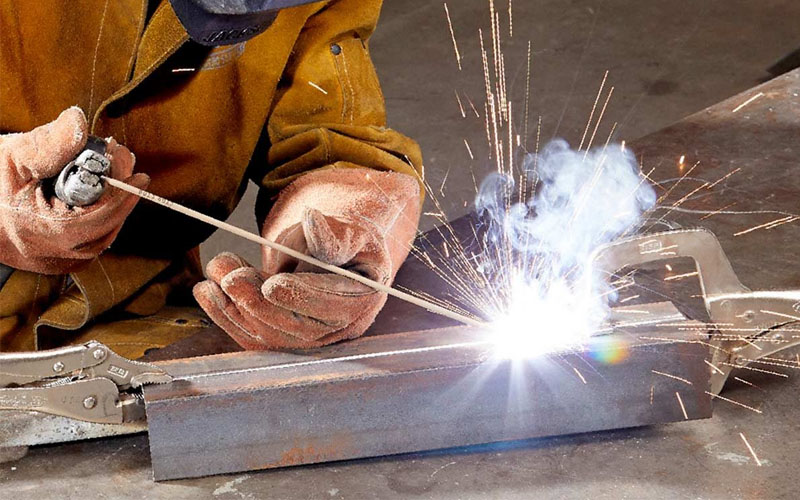
Manual arc welding is only applied in the case of on-site repairs, structures that do not require high aesthetics, or in places where there are no conditions to operate modern machinery.
In addition, SAW (submerged arc welding) is also applied in some large-scale industrial spiral welded steel pipe factories. With the ability to fully automate welding, high productivity and stable welds, deep penetration, SAW is especially suitable for creating large-diameter, thick-walled pipes that require high pressure resistance. The SAW system is often integrated with a spiral winding machine and an automatic flux feeder, helping to ensure consistent weld quality and save labor. However, due to technical characteristics, SAW is mainly applied to longitudinal or flat welding, so it is often used in the main stage in factories with fixed lines, less suitable for complex construction terrain.
4. Overview comparison of welding methods
| Criteria | TIG Welding | MIG Welding | Manual arc welding | SAW Welding |
|---|---|---|---|---|
| Weld quality | Very high | High | Average – depends on skill | Very high, deep penetration, stable |
| Weld speed | Slow | Fast | Slow | Very fast – suitable for continuous welding |
| Automatical capabilities | Low | High | No | Very high – integrated chain |
| Investment costs | High | Medium – high | Low | Very high – need synchronized system |
| Application of SSAW | Limitations (additional details) | Very suitable (main production) | Less suitable (site construction) | Suitable for large, thick-walled chains |
E.NHAT Group is currently using the Lincoln Power Wave AC/DC 1000SD submerged arc welding machine – a high-end device for deep, stable welds, suitable for large-scale spiral welded steel pipe production.
5. Which welding technology should be chosen for spiral welded steel pipes?
6. New trends in spiral welded steel pipe welding technology
Conclusion
Each welding method – TIG, MIG, manual arc or SAW – has its own advantages and disadvantages, depending on the product requirements and construction conditions. In the production of spiral welded steel pipes, automatic MIG welding is still the most optimal method, ensuring both technical and economic efficiency. However, for large-scale factories that need to weld large-diameter, thick-walled pipes and require high-pressure welds, SAW (submerged arc) welding is the optimal choice thanks to its stability, high speed and comprehensive automation.
E.NHAT – A reputable supplier of spiral welded steel pipes in Vietnam
With many years of experience in the field of industrial mechanics, E.NHAT Industrial Joint Stock Company is proud to be a manufacturer and supplier of spiral welded steel pipes that meet quality standards, serving a variety of fields such as: construction, irrigation, transportation, electricity, …
✅ Invest in automatic submerged arc welding machines, especially suitable for large diameter spiral welded steel pipe products.
✅ Modern spiral welding line, flexible production capacity according to requirements.
✅ Nationwide delivery – on schedule – in accordance with technical standards.
📞 Contact E.NHAT now to get advice on the best spiral welded steel pipe solution for your project!